Friday, February 21, 2014

Hackamore Acres

When our local grocery store was built six years ago, I was glad that I could now walk just a mile to do my shopping, but grieved a little for another patch of desert that was transformed into seventy-five acres of asphalt and concrete. Fortunately, the other half of this island surrounded by a moat of roadways between Hackamore and Happy Valley Road, still remains for me to wander and to study the natural and unnatural history there. From the air, the desert side shows a maze of trails created by wildlife and the occasional human passing through. The mall side appears to have nothing growing at all, but this is hardly true. 
This week I made a comparative floral inventory of the two parcels of land. Creosote bush is the dominant plant on the wild side, with a few mesquites, palo verde and wolfberry shrubs mingling in.   Patches of globe mallow (Spaeralcea ambigua) and African chamomile (Oncosiphon piluliferum) flourish wherever there is a little cover from deadfall or a dip in the landscape where soil and water accumulate.  Over forty other species of plants seek refuge in the shade of the larger shrubs. A few hardy annuals, especially plantain (Plantago ovata) and burrcomb (Pectocarya recurvata), colonize the wide expanses of otherwise bare earth.  Quail, ground squirrels, desert cottontail, white-crowned sparrows and lizards are some of the critters that make a living here too. 


Crossing the curbed boundary between the two sides of Hackamore Acres, the diversity of plants and animals that occupy the parking lot are entirely different. Well, obviously. Except for a few token creosotes and triangle leaf bursages, all of the forty-one species that have been selected to live in the sea of asphalt are not found in the wild desert next door. Landscapers do a thorough job of weeding out the few introduced species that have established on the desert side.  Even the birds are different. Over in the parking lot and on sidewalks, you're more likely to see house sparrows, pigeons and grackles. This is a distinctly urban ecology. But this is also a miracle! That anything can survive in this radically altered landscape is, in some ways, a testimony to the power and resilience of life.


I've come to appreciate both sides of Hackamore Acres. I admire the trees and shrubs that can survive (albeit with an IV of sorts, water and nutrients provided through a drip system) in the super-heated environment of the parking lot. Emu bush, rosemary, oleander and lantana are year-round sources of nectar, pollen, seeds and leaves for birds and insects to feed on. Willow acacia, if left untended for more than a few months, will sprout many seedlings. Surely they would form a forest in the future if we ceased pruning, weeding and hosing the gravel with herbicides.

I romanticize the wildness of creosote flats that smell so sweet after a rainstorm. Arizona poppies and spiderling that erupt from seemingly barren soils after a good monsoon rain remind me that no matter what abuses we torture the earth with, seeds blown in will restore the land in time. Life is patient.



Tuesday, February 11, 2014

Stone Buster

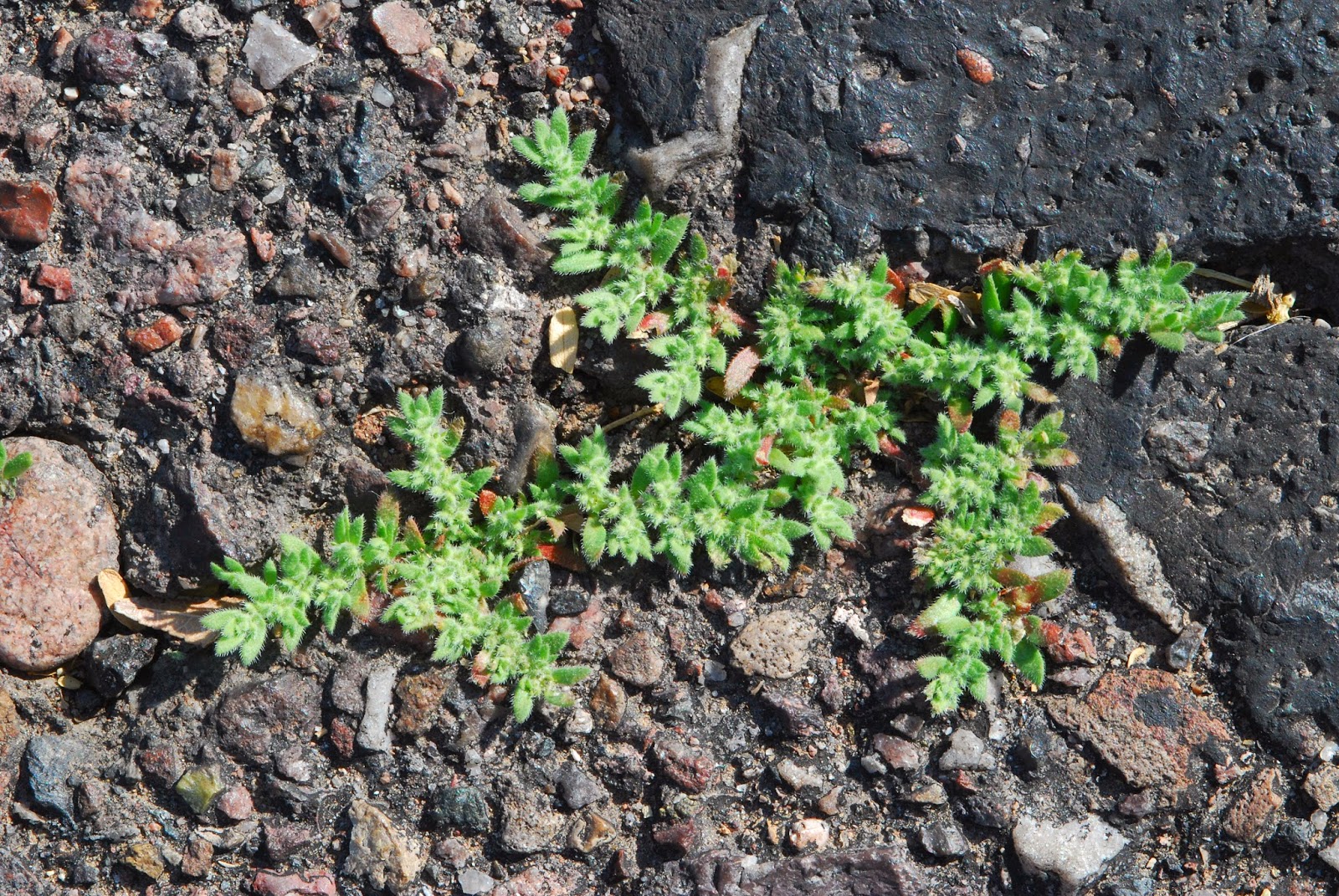
You gotta love a plant that was given the name Hairy Rupturewort (Herniaria hirsuta). With a name like that, you better be tough, and tough it is. This inconspicuous little plant lives in cracks, or ruptures, in the asphalt of our neighborhood streets, one of the hottest, driest environments a plant could take root in.  Peering at it through my hand lens, I saw that the leaves are covered with soft hairs. Although the cracks probably began due to the natural heaving of the earth, rupturewort and other plants that occupy this microhabitat help to widen the cracks. Oblivious, or at least unhindered, by the local traffic, rupturewort adds sinuous stripes of green to the road. The plant's natural habitat in northern Africa is probably in similar cracks in rocks.


Rupturewort was imported to North America as a horticultural marvel and herbal remedy. Another species, Herniaria glabra, or smooth rupturewort (i.e. not hairy), is marketed as a "carpet" plant to use in walkways, and as medicinal tea or extract. You can even purchase a poster that includes a botanical illustration of rupturewort.

Moroccan urologist, Fouad Atmani, has been experimenting with rupturewort to better understand its effects on kidney stones. His 2004 article, Effect of herb extract from Herniaria hirsuta on calcium oxalate crystallization in vitro; and another published in 2003, Effect of aqueous extract from Herniaria hirsuta on experimentally induced calcium oxalate nephrolithiasis in rats, document that the herb is indeed useful in dealing with kidney stones, although it does not actually rupture, or break them. What it does do is inhibit the stones from adhering to kidney tissue, which helps to reduce mineral build-up and the excruciating pain and other side effects that comes with it.  Extracts from the plant have been used for centuries as a medicinal remedy to treat kidney stones and as a diuretic. Now Dr. Atmani's research has shown that early herbalists seemed to know what they were doing.

Is it a divine synchronicity that my fascination with this plant coincided with my own personal episode of kidney stones? The world works in mysterious ways! Time to make some rupturewort tea. Fortunately, there is a plentiful supply in the street.

Wednesday, December 4, 2013

Urban Refuge

Male monarch resting in a mesquite tree       photo by Richard Halliburton
One of the greatest wonders of the natural world is the annual migration of millions of monarch butterflies from eastern North America to fir forests deep in southern Mexico each winter. But Michoacan, Mexico is not the only place that monarchs overwinter. Right here in central Phoenix, teams of butterfly scientists, or lepidopterists, have been tracking monarchs that overwinter along the Salt River, as well as along the Colorado River near Yuma and Parker, Arizona. Numerous "hot spots" around the state of Arizona, from Grand Canyon in the north to Patagonia in the south, also attract monarchs to feed and breed at various times of the year.

Monarchs are very selective about what species of plant they will lay eggs on, since the caterpillars are adapted to feed almost exclusively on milkweeds. However, the adults will gather nectar from a wide variety of flowers. Even though they are endemic to North America, monarchs are happy to feed on plants imported from the Mediterranean, such as lantana and rosemary, or Australia, such as eucalyptus and wattle trees.

Female monarch nectaring on a wattle tree
For roosting, though, they need just the right kind of canopy and just the right kind of leaves to hang onto with their tiny feet, says Gail Morris, director of the Southwest Monarch Study.  Gooding's willows, large trees native to Arizona, are their favorite at the riverside location in central Phoenix. At least that is where they have been noticed by people who pay attention to these sorts of things. It is quite possible that they are hanging out in the eucalyptus trees in your neighborhood, as they do along the coast of California. If you see monarch butterflies floating around your neighborhood this winter, people want to know, especially if you can see a tiny round tag with numbers on its wing. These tags are one way scientists are keeping track of butterflies that roam through Phoenix. You can report your sightings, with or without tags, to swmonarchs@yahoo.com.

Photos are excellent documentation too, since it is easy to confuse a monarch with the more abundant and closely related queen and occasional viceroy butterflies that also flutter around these parts. Learn the differences here: Identifying Monarch Butterflies.

Sunday, December 1, 2013

Stalked Puffball


My greatest excitement today was finding this stalked puffball, Battarrea diguettii, on my morning walk. This is a new species for my "life list," and the second type of stalked puffball I've seen growing around Phoenix. It's a wonder that the neighborhood isn't covered with these strange fungi, as the spores must number in the billions from just this one specimen. This and other members of the genus Battarrea have lots of folk names: sandy stiltball, desert drumstick and donkey fungus are the most common. A close relative of this species, Battarrea phalloides, has been found all over the world, from Africa and Oahu to Uruguay, where none other than Charles Darwin collected specimens in 1833. Diguettii is distinguished by the pores on the cap that release the powdery spores, and is endemic to the Mojave and Sonoran deserts of North America.


Wednesday, November 20, 2013

Life and Death

Around here, if a scorpion doesn't get you, the ants will. This Arizona desert scorpion (Hadrurus arizonensis) I found on the sidewalk probably met its death by a crushing foot, but it did not take long for tiny Southern fire ants (Solenopsis xyloni) to swarm in for a feast.  At least the scorpions usually hunt solo. 

Also known as the Giant Hairy Scorpions for short stiff hairs along the sides of their legs, this species is reputed to be the largest in the U.S., measuring up to six inches long from the tip of their stinger to the small, sharp jaws or chelicerae. Add on all those legs plus the formidible claws, or pedipalps, and they are quite impressive. This one was about four inches long based on my calculations as sized up to my pen. (I need to add a small ruler to my pack for observations like this.) The ants are just a teensy fraction-maybe a sixteenth of an inch-or a couple of millimeters apiece if you prefer metric. Although scorpions can deliver a painful sting, they rarely cause a serious reaction in humans, and this one is actually one of the least toxic, despite its size. The dark back and pale legs also distinguish this species from the smaller, more dangerous and much more common bark scorpion (Centruroides exilicauda) that haunts the SW deserts. 
As gruesome as a scene like this may be, it is a reminder that all life thrives on death, humans included...unless you like your meat very fresh!

Thursday, November 14, 2013

Exoskeletons

After a month or two spent mucking about in a pond for food, the aquatic larvae, or nymphs, of dragonflies crawl out of the water, crack open the skin on their back, and begin new lives as aerobatic adults. I found these exoskeletons, or exuvia, of roseate skimmers (Orthemis ferruginea) clinging to a cement wall along the Central Arizona Project canal, where a trough of still water serves as a year round breeding ground for dragonflies, as well as dozens of other insects. The exuvia are perfect casts of the fearsome jaws and giant eyes that make the larvae successful predators. I would like to have witnessed the magical hour when dragonflies emerged from these chitonous skins. Even more, I would like to be able to shed my own skin and fly! 
This trough on top of the CAP canal collects debris and mud,
creating a year-round pond that is brimming with aquatic life.
An adult Roseate Skimmer rests on a blade of grass.
Dragonfly larvae blend in with muck at the bottom of the pond.


Wednesday, November 6, 2013

Mussels and Clams


Quagga mussels (Dreissena rostriformis ssp. bugensis) and Asian clams (Corbicula fluminea) have claimed some territory along the Central Arizona Project canal, far from their native habitats in Ukraine and southeast Asia respectively. A small pile of shells is spread out across the trail after being scraped out of pipes in a water treatment plant in north Glendale, looking quite out of place in this arid scene.

Hitching rides on ships and then on smaller boats, both species have become naturalized in many freshwater systems in North America including the Colorado River and its system of reservoirs and canals. The clams are considered to be symbols of prosperity in Asia and have also been intentionally introduced through the aquarium trade and as a source of food.